
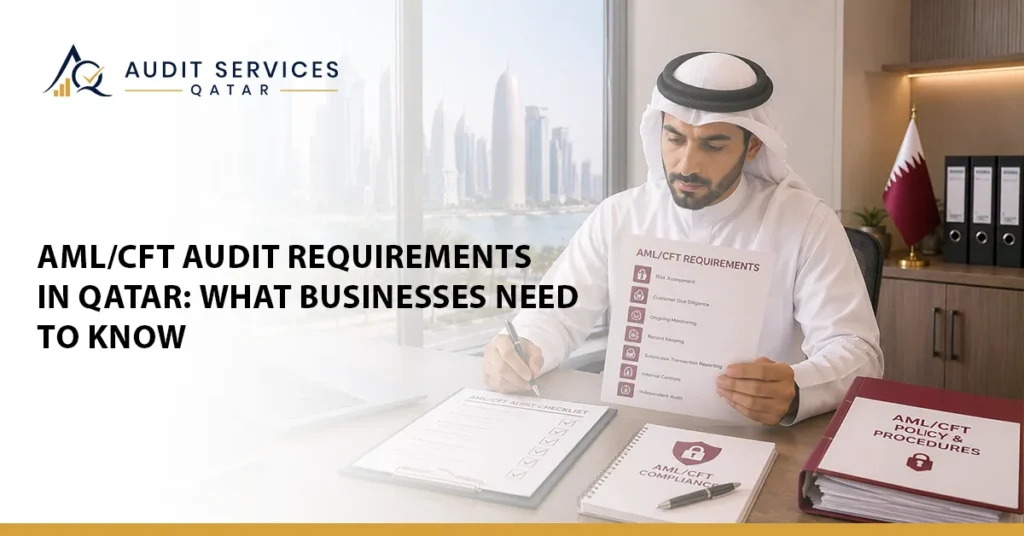
AML compliance is an important part of Qatar’s regulatory framework for businesses that fall within the scope of anti-money laundering and counter-terrorism financing obligations. Companies and professional firms must establish controls that identify customers, assess risk, understand beneficial ownership, monitor transactions and report suspicious activity where required. Qatar’s framework is based on Law No. 20 of 2019, its Implementing Regulations under Council of Ministers Decision No. 41 of 2019, Decree Law No. 19 of 2021, and sector-specific rules issued by supervisory authorities.
What Is AML/CFT Compliance in Qatar?
AML/CFT compliance refers to the policies, procedures, systems and controls that an organisation uses to prevent, detect and respond to money laundering and terrorism financing risks. The requirements differ according to the nature of the business, its regulatory status, customer profile and exposure to financial crime.
The Qatar Financial Information Unit receives and analyses suspicious transaction reports from financial institutions and designated non-financial businesses and professions. This makes accurate customer information, risk assessment, transaction monitoring and reporting procedures important parts of a business’s control framework.
Why Does AML Compliance Matter for Qatar Businesses?
Effective AML compliance helps a business demonstrate that it has taken reasonable steps to identify and manage financial crime risks. It also supports stronger governance, more reliable customer records and clearer internal accountability.
For regulated entities and relevant DNFBPs, compliance is not simply a matter of having a written policy. Controls need to operate in practice, remain current and reflect the risks faced by the business. Qatar’s official framework includes sector-specific requirements for financial institutions, auditors, lawyers, real estate agents, authorised notaries and other covered businesses.
A weak framework can leave gaps in customer due diligence, beneficial ownership verification, suspicious transaction reporting, employee training and record retention. An independent review can help management identify those weaknesses before they develop into more serious regulatory issues.
Which Businesses Need AML/CFT Controls in Qatar?
The scope depends on the sector and the applicable supervisory authority. Financial institutions supervised by the Qatar Central Bank have specific AML/CFT instructions, while businesses and professions classified as DNFBPs are subject to requirements issued under the national framework and relevant supervisory rules.
The Ministry of Commerce and Industry has issued AML/CFT Compliance Rules for auditors, dealers in precious metals or precious stones, and trust and company service providers. The Ministry of Justice also has separate AML/CFT regulations for lawyers, real estate agents and authorised notaries. QFC-regulated firms follow the rules applicable within the Qatar Financial Centre. Businesses should therefore establish their obligations based on their legal structure, activities, licence, regulator and customer exposure rather than relying on a generic compliance checklist.
What Does an AML/CFT Review Examine?
An effective review looks beyond the existence of policies. It tests whether the organisation has implemented controls that work consistently.
Customer Due Diligence
The review considers whether the business identifies and verifies customers appropriately, collects required information and applies enhanced measures when higher-risk circumstances arise.
Beneficial Ownership
The reviewer examines whether the organisation understands who ultimately owns or controls a customer or acts on whose behalf a transaction is conducted. Inadequate beneficial ownership information can weaken the entire risk assessment process.
Risk Assessment
A business should identify the money laundering and terrorism financing risks associated with its customers, products, services, delivery channels and geographic exposure. The review assesses whether the risk methodology is documented, reasonable and applied consistently.
Transaction Monitoring
Where applicable, controls should identify unusual or suspicious activity and provide a clear process for escalation and investigation. The review can examine monitoring rules, alerts, investigation records and management oversight.
Suspicious Transaction Reporting
Reporting entities in Qatar must report suspicious transactions to the QFIU in accordance with the applicable law, guidance and supervisory instructions. A review therefore considers whether staff understand escalation procedures and whether reporting responsibilities are clearly assigned.
Record-Keeping
Records should support the organisation’s ability to demonstrate how customers were identified, how risks were assessed and how relevant transactions or investigations were handled. The review examines whether records are complete, accessible and retained in accordance with applicable requirements.
Training and Staff Awareness
Policies are only effective when employees understand their responsibilities. A review can assess training programmes, attendance records, role-specific instruction and staff understanding of escalation requirements.
What Is the Role of an Independent AML/CFT Review?
An independent review provides management with an objective assessment of the effectiveness of its AML/CFT framework. It can identify control gaps that may not be visible to employees responsible for day-to-day compliance.
Qatar’s official guidance for auditors states that an AML/CFT programme should include an independent audit and review function to test compliance with policies, procedures, systems and controls. The guidance also expects appropriate and ongoing review and assessment of policies.
The scope and frequency of an independent review should reflect the organisation’s regulatory obligations and risk profile. Businesses should not assume that one fixed review cycle applies to every entity across Qatar because supervisory requirements can differ by sector.
What Should an External Audit Report on AML Compliance Include?
The resulting report should clearly explain the scope of the review, areas examined, testing performed, significant findings and recommendations for improvement. The report should distinguish between documentation gaps, control weaknesses and areas where the organisation appears to meet the applicable requirements.
A useful report should give management enough information to understand the risk, determine responsibility and establish corrective actions. Where deficiencies exist, the report can include practical recommendations, priority levels and suggested remediation steps.
The report should also make clear what was reviewed and what was outside the engagement scope. This prevents management and other stakeholders from treating a limited compliance review as an assurance statement over every aspect of the organisation.
How Can Businesses Prepare for an AML/CFT Review?
Preparation should begin with a review of the organisation’s regulatory obligations and existing control framework.
Businesses should organise key records such as:
- Current AML/CFT policies and procedures
- Enterprise or business-level risk assessments
- Customer identification and verification records
- Beneficial ownership documentation
- Higher-risk customer reviews
- Transaction monitoring and investigation records
- Suspicious transaction reporting records, where applicable
- Employee training records
- Compliance officer documentation
- Previous review reports and remediation evidence
Management should also confirm that policies reflect current requirements and that documented procedures match what employees actually do. A policy that describes a process that does not operate in practice can create a significant control weakness.
What Are Common AML/CFT Control Weaknesses?
Several weaknesses can reduce the effectiveness of an organisation’s framework. These include incomplete customer files, outdated risk assessments, insufficient beneficial ownership information, inconsistent customer risk ratings and weak evidence of ongoing monitoring.
Other issues can arise when employee training is irregular, compliance responsibilities are unclear or management does not track remediation of previous findings.
Businesses should also avoid treating screening software or written policies as substitutes for effective oversight. Technology can support compliance, but employees still need clear procedures for reviewing alerts, escalating concerns and documenting decisions.
How Can AML Consulting Support Businesses in Qatar?
Professional advisory support can help businesses assess their current framework, identify compliance gaps and strengthen policies, procedures and internal controls. Professional support can be particularly useful when a business is establishing a new compliance programme, preparing for a regulatory review or addressing findings from an earlier assessment.
The scope of support may include risk assessments, policy reviews, customer due diligence procedures, beneficial ownership controls, transaction monitoring frameworks, training and independent testing.
The right approach depends on the business’s sector and risk profile. A regulated financial institution may require a substantially different framework from an accounting firm, real estate business or corporate service provider.
What Should Businesses Look for in Audit Firms in Qatar?
Businesses should assess whether a prospective provider understands Qatar’s AML/CFT legislation, supervisory requirements and the organisation’s particular sector.
Relevant experience matters because the applicable obligations can differ between regulators and business categories. A provider should also be able to explain its review methodology, scope, evidence requirements, reporting approach and remediation process before the engagement begins.
Businesses should avoid selecting a provider solely because it offers a low fee. The quality of the review depends on the reviewer’s regulatory knowledge, testing approach and ability to identify practical control weaknesses.
How Do Auditing Companies in Qatar Help With AML Reviews?
Qualified providers can support businesses by independently assessing documented controls and testing whether those controls operate as intended. Depending on the engagement, this may involve reviewing customer files, risk assessments, internal procedures, reporting processes, training records and evidence of management oversight.
For businesses that fall under specific professional or supervisory rules, the reviewer should also consider the requirements issued by the relevant authority. This helps ensure that the assessment reflects the rules that actually apply to the organisation.
Is Eisa Alderbasti Accounting and Auditing Relevant to AML Reviews?
Businesses researching providers may encounter this firm when comparing accounting and auditing providers in Qatar. Any organisation considering an engagement should independently confirm the provider’s current registration, professional credentials, relevant AML/CFT experience and the precise scope of services before appointing a firm.
This is particularly important because an AML/CFT compliance review can have a different scope from a statutory financial statement audit. Management should understand exactly what assurance or assessment the engagement provides.
What Are the Benefits of Regular AML/CFT Reviews?
Regular reviews can help businesses identify weaknesses before they become persistent compliance problems. They also give management documented evidence of oversight and create a structured basis for remediation. The benefits can include:
- Better visibility over financial crime risks
- Stronger customer due diligence controls
- More reliable beneficial ownership information
- Clearer reporting and escalation procedures
- Improved staff awareness
- Better documentation and record management
- More structured remediation of control weaknesses
A review should not be treated as a one-time exercise. AML/CFT risks can change as a business expands into new markets, introduces new services, changes its customer base or adopts new delivery channels.
How Can Audit Services Qatar Help?
Audit Services Qatar can support businesses that need an independent assessment of their AML/CFT framework, documentation and internal controls. The engagement can be structured around the organisation’s activities, regulatory requirements and identified risk areas.
The process can begin with an understanding of the business and its regulatory position, followed by a review of policies, risk assessments, customer controls, reporting arrangements, training and relevant records. Findings can then be documented with practical recommendations to support management’s remediation programme. Businesses should seek professional support when they need an objective view of their existing controls, are preparing for regulatory scrutiny or want to strengthen their governance framework.
Conclusion
Strong AML/CFT controls help Qatar businesses demonstrate that they understand and manage financial crime risks. Effective aml compliance requires more than a written policy. It needs appropriate customer due diligence, beneficial ownership controls, risk assessment, monitoring, reporting, record-keeping, training and independent oversight.
Maintaining AML compliance also requires businesses to keep their frameworks current as regulatory expectations and operational risks develop. As Qatar continues to strengthen cooperation between its financial intelligence and supervisory authorities, businesses should keep their compliance frameworks current and evidence-based. The QFIU continues to work with national supervisory authorities to strengthen the effectiveness of suspicious transaction reporting and financial crime controls.
Frequently Asked Questions
Is AML/CFT compliance mandatory in Qatar?
Yes, entities covered by Qatar’s AML/CFT framework must comply with the applicable legal and supervisory requirements. The exact obligations depend on the entity’s sector, activities and regulator.
Does every business need an independent AML/CFT audit?
Not necessarily under one identical rule. Requirements differ by sector and supervisory framework. Businesses should determine whether an independent audit or review function applies to their specific regulatory position.
What is the difference between an AML/CFT review and a financial audit?
A financial audit primarily examines financial statements against applicable financial reporting and auditing standards. An AML/CFT review focuses on controls designed to prevent, detect and report money laundering and terrorism financing risks.
What happens after an AML/CFT review?
Management should assess the findings, assign responsibility, establish remediation actions and monitor progress. Significant issues may require prompt corrective measures depending on the applicable regulatory requirements.