
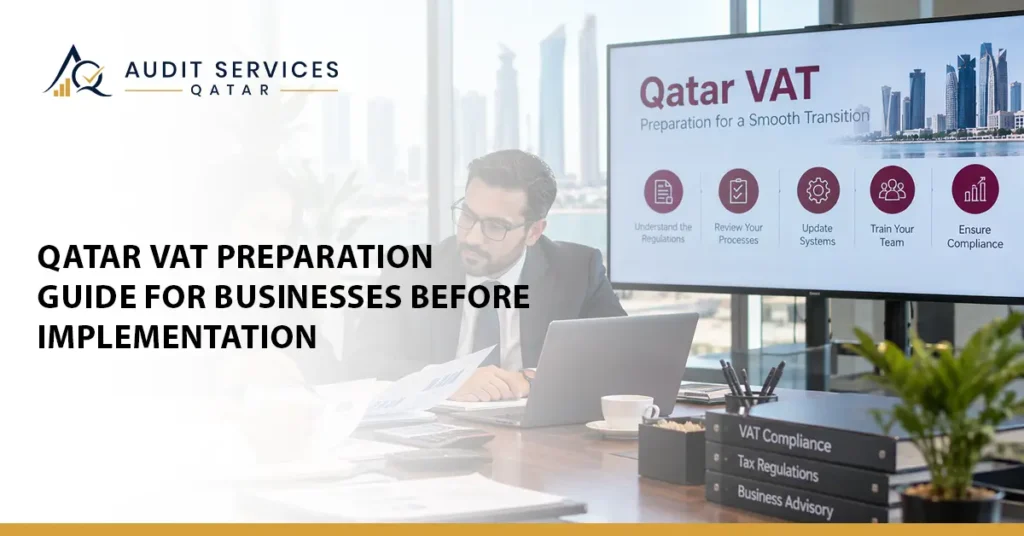
Businesses operating in Qatar should begin preparing for VAT implementation in Qatar even though the country has not yet published the final VAT law and executive regulations. As of February 2026, Qatar had not introduced VAT, while the anticipated framework is expected to follow the GCC VAT model. The commonly anticipated rate is 5%, but businesses should not treat the rate, registration thresholds, exemptions, filing periods, or effective date as final until the Qatari authorities publish the applicable legislation.
For companies, preparation is less about charging tax today and more about making sure finance, contracts, pricing, systems, records, and internal controls can respond quickly when the rules become effective. A structured readiness review can identify gaps before they become compliance problems and give management enough time to test processes.
Qatar VAT Implementation Status
Qatar has signed the GCC Value Added Tax Framework Agreement, which provides the regional foundation for introducing VAT through national legislation. However, the Qatar-specific VAT law and executive regulations have not yet been published. Current tax information confirms that Qatar does not presently impose VAT or a general sales tax on domestic operations.
This distinction is important for businesses planning ahead. References to the expected 5% rate or possible registration requirements should be presented as preparation assumptions rather than confirmed obligations. Companies should monitor announcements from the General Tax Authority and update their implementation plans when official rules become available. The GTA continues to operate and expand its digital tax administration environment, including the Dhareeba platform.
Why Businesses Should Prepare for VAT Before Implementation
A new indirect tax can affect much more than the finance department. It can change how businesses price products, issue invoices, record purchases, negotiate contracts, manage working capital, and communicate with customers and suppliers. Complex operations may require more time to map these effects.
Early preparation also gives management an opportunity to identify transactions that may require special treatment under the eventual legislation. Instead of waiting for the final deadline, businesses can establish a project team, document existing processes, review data quality, and create a controlled plan for system and process changes.
Key Steps for Qatar VAT Preparation
Review Business Transactions
Start by creating a detailed map of revenue and expenditure streams. Businesses should identify the goods and services they sell, the jurisdictions involved, customer categories, supplier arrangements, imports, exports, intercompany transactions, and other activities that could have indirect tax consequences.
The purpose is to create a transaction inventory that can be reviewed against official rules once published. Businesses should also identify transactions where contracts, invoices, or supporting documents are incomplete.
Assess VAT Impact on Pricing
Businesses should model how a potential VAT charge could affect selling prices, margins, discounts, commissions, and customer agreements. This is particularly important where prices are contractually fixed or where customers expect quoted amounts to include all taxes.
Management should run scenarios rather than assuming that tax will simply be added to every price. The eventual rules may distinguish between taxable, zero-rated, exempt, or out-of-scope transactions.
Prepare Accounting Records
Clean accounting data is essential for indirect tax readiness. Businesses should review their chart of accounts, general ledger structure, customer and supplier master data, invoice records, purchase documentation, and reconciliation procedures.
Finance teams should be able to trace a transaction from its source document through the accounting system to the relevant financial report. They should also maintain a clear audit trail for adjustments, credit notes, refunds, and unusual transactions. Strong documentation will make future VAT reporting easier and support the business if the tax authority requests evidence.
Prepare for VAT Ledger Treatment
Finance teams should prepare for the accounting changes that may follow implementation. Although the exact treatment will depend on the final Qatari rules, businesses can assess how tax collected from customers and eligible tax paid to suppliers may need to be separately tracked in their ledgers.
Testing potential VAT accounting entries before go-live can help identify weaknesses in account mapping, tax codes, automated postings, and reconciliation controls. The objective should be to ensure that tax-related balances can be reconciled to invoices and supporting records rather than relying on manual calculations at the end of each reporting period.
Update Accounting and ERP Systems
Businesses should determine whether their accounting software and ERP platforms can support the eventual VAT requirements. The review should cover tax codes, invoice formats, customer and supplier records, transaction classifications, reporting, credit notes, refunds, imports, exports, and data extraction.
System configuration should remain flexible until official requirements are released, allowing rates, codes, and reporting fields to be updated efficiently.
Review Business Contracts
Existing contracts deserve particular attention because VAT can affect the economic value of an agreement. Companies should review clauses covering taxes, pricing, invoicing, gross-up arrangements, payment terms, reimbursements, and changes in law.
New agreements can include appropriate tax language where legally and commercially suitable. Existing contracts should be assessed to determine whether additional documentation or customer communication may be required once VAT becomes effective.
Prepare VAT Documentation
Businesses should establish document-retention and approval procedures before implementation. Relevant records may include invoices, purchase documents, contracts, customs documentation, credit notes, debit notes, payment evidence, and accounting reconciliations.
Document controls should make evidence easy to retrieve. High-volume businesses should also consider automated document management and consistent reference conventions. A reliable record trail reduces the risk of missing information when returns or tax reviews eventually become part of normal operations.
How Businesses Can Ensure VAT Compliance
VAT readiness should include a written compliance process covering responsibilities, approvals, review controls, filing preparation, reconciliations, and management sign-off. Once the final legislation is available, the business should convert this framework into a detailed compliance calendar based on the actual registration and filing requirements.
Businesses should also understand the relevant electronic channels. Qatar already uses the Dhareeba Tax Portal for tax administration, and the General Tax Authority continues to expand digital taxpayer services. This makes it sensible for businesses to ensure that authorized personnel, tax registrations, supporting data, and internal approval procedures can work with the authority’s digital environment when VAT-related services become available.
The compliance process should be tested before the first filing. A mock reporting cycle can reveal missing data, classification errors, reconciliation differences, approval delays, and system limitations. These issues are easier to resolve during preparation than after a filing deadline.
Common VAT Preparation Challenges
One common challenge is treating VAT as an accounting-only project. In reality, indirect tax can affect sales, procurement, logistics, legal agreements, information technology, finance, and senior management. A cross-functional approach helps ensure that changes are coordinated.
Another challenge is relying on unconfirmed information. Because Qatar’s final VAT legislation and executive regulations have not yet been published, businesses should avoid hard-coding assumptions about rates, exemptions, thresholds, or filing dates into policies and customer communications.
Data quality can also become a major obstacle. Duplicate customer records, inconsistent product descriptions, missing tax information, and incomplete supplier documents can make implementation unnecessarily difficult. A data-cleaning exercise before system configuration can reduce these risks. Finally, employee training should not be left until the final stage. Staff involved in quotations, invoices, purchases, expenses, and contracts may all need to understand their responsibilities.
How Tax Consultants Can Support VAT Preparation
Professional support can help businesses translate the future legislation into practical processes. A tax advisor can assist with transaction mapping, readiness assessments, system reviews, documentation, compliance planning, and staff training once the official requirements are known. Audit Services Qatar provides assurance services to help businesses strengthen financial controls, improve reporting reliability, and prepare for changing compliance requirements. Its assurance-focused approach can support the review of accounting processes, documentation, reconciliations, and internal controls that may become important during VAT implementation.
Audit Services Qatar provides assurance services that can also help management assess whether financial data and supporting processes are sufficiently reliable for a new indirect tax environment. This can include reviewing control gaps, identifying reconciliation issues, and improving the consistency of financial documentation. For businesses with more complex operations, Audit Services Qatar provides assurance services alongside structured financial review support, helping management establish stronger processes before new reporting obligations take effect. The focus should remain on practical readiness rather than assumptions about rules that have not yet been finalized. As requirements develop, Audit Services Qatar provides assurance services that can complement tax-readiness activities by strengthening the underlying financial information used for compliance. Businesses can benefit from having reliable records, clear controls, and documented processes before they begin preparing actual VAT returns. Through its broader professional support, Audit Services Qatar provides Assurance Services designed to help businesses improve confidence in financial information and internal processes. Companies can use this preparation period to address control weaknesses, improve documentation, and establish a more disciplined approach to future tax compliance.
Prepare for Digital VAT Processes
Businesses should also plan for digital compliance. Qatar already operates the Dhareeba platform for tax administration, so finance teams should be ready to adapt their internal approvals, user access, supporting records, and submission controls when official VAT functionality becomes available. The phrase VAT online services should be treated as part of the wider digital-readiness discussion rather than as a current VAT obligation.
Companies can develop an internal workflow covering invoice review, transaction classification, reconciliation, approval, filing preparation, and evidence retention. However, the final vats procedure should only be formalized after Qatar publishes the applicable legislation and administrative guidance. This prevents businesses from building fixed processes around assumptions that may later change.
Management should also assess the expected Qatar VAT tax impact across sales, purchases, imports, exports, contracts, and pricing. This review can identify areas where external tax or assurance support may be useful. Most importantly, vat implementation in Qatar should be treated as a cross-functional project involving finance, sales, procurement, legal, IT, and management. Businesses should maintain a documented readiness plan and update it as official information develops. A structured approach to VAT implementation in Qatar can help companies identify data gaps, strengthen controls, and prepare staff before operational changes are required. It also allows businesses to test systems and reporting processes rather than making rushed changes close to the effective date.
Companies should continue monitoring official announcements because VAT implementation in Qatar remains dependent on the publication of final national legislation and regulations. Once those requirements are confirmed, businesses can validate their assumptions, finalize configurations, and move into formal compliance. For this reason, VAT implementation in Qatar should remain on the management agenda even before the final effective date is known. Early planning creates time to review contracts, accounting structures, documentation, technology, and internal controls in a measured way.
Conclusion
Preparing for VAT implementation in Qatar should be treated as a business transformation and compliance-readiness project rather than a last-minute accounting exercise. Qatar currently has no VAT in force, and the final national legislation and executive regulations remain essential before businesses can determine their exact obligations.
Companies can nevertheless act now by reviewing transactions, assessing pricing, improving accounting records, preparing systems, reviewing contracts, strengthening documentation, and training relevant employees. They should also monitor official announcements and update their readiness plans when the final rules are published.
A disciplined preparation process can reduce operational disruption and give businesses greater control over the transition. By combining sound financial controls with timely regulatory monitoring, Qatar businesses can be better positioned to respond when the country’s VAT framework becomes effective.
FAQs:
Is VAT currently implemented in Qatar?
No. Qatar has not yet implemented VAT, and businesses should wait for the official VAT law and executive regulations before treating specific rates, thresholds, or filing requirements as confirmed.
What should businesses do before VAT is introduced in Qatar?
Businesses should review their transactions, accounting records, pricing, contracts, ERP systems, documentation, and internal controls so they can adapt quickly when the final requirements are announced.
Will VAT affect accounting systems in Qatar?
Yes. Once VAT is implemented, businesses may need to update accounting systems to handle tax codes, invoices, tax-related ledger accounts, reporting, reconciliations, and other compliance requirements.
Why is early VAT preparation important for businesses?
Early preparation gives businesses time to identify data and process gaps, assess the potential financial impact, update systems, train employees, and establish controls without making rushed changes close to implementation.
Can Audit Services Qatar help businesses prepare for VAT?
Yes. Audit Services Qatar provides Assurance Services that can help businesses review financial processes, strengthen internal controls, improve documentation, and assess the reliability of information needed for future tax compliance.